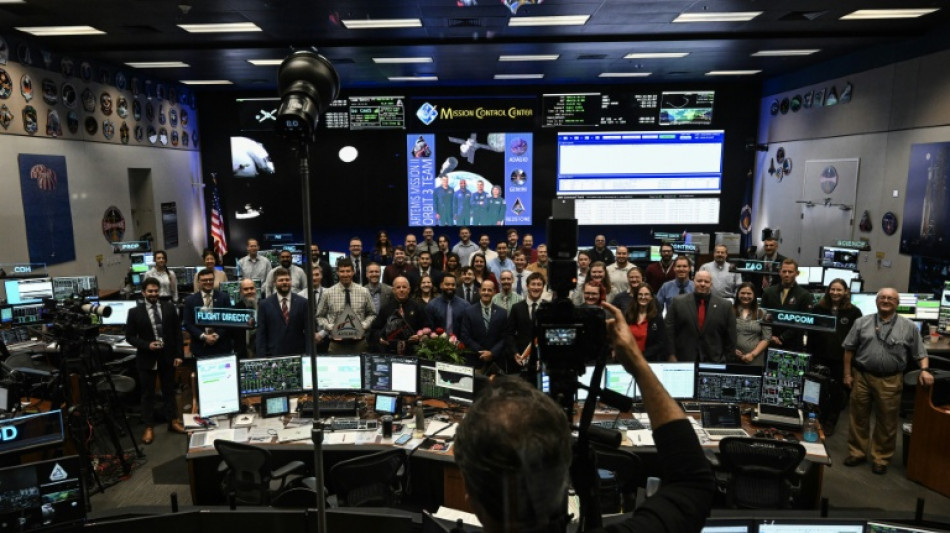
'Morale boost': NASA carries out Moon mission during tough year for science / Photo: RONALDO SCHEMIDT - AFP
As the four Artemis astronauts approached a high point of their lunar mission -- getting slung around the far side of the Moon -- NASA staffers crowded into Houston's famed mission control room Monday for a team photo.
They were all smiles as countdown clocks ticked and the Orion spacecraft flew ever closer to Earth's cratered neighbor, a mission years in the making come to fruition at last.
By most metrics it's been a rough year for science in the United States -- the Trump administration has slashed funding, halted projects and devastated workforces.
But then, NASA sent astronauts around the Moon for the first time in half-a-century, deeper into space than ever before.
The moonshot has served as a "massive positive moment," said exploration scientist Jacob Bleacher.
"People have been working on this for months, years -- over a decade in some cases," he told AFP.
The majority of Americans, including NASA scientists, weren't yet born when the Apollo era first sent astronauts to the Moon in the late 1960s.
The myth loomed large, but it was past tense -- until now.
"It's just surreal," said Bleacher, speaking from NASA's Science Mission Operations Room in Houston's famed Johnson Space Center.
"This is my generation's first chance to step up and really do this," he said.
"I like to think about it as walking through a doorway into how humankind explores the solar system going forward."
- 'Reinvigorate' -
US President Donald Trump has pressured NASA to get boots on the lunar surface before his second term ends in 2029.
But just last week the White House simultaneously proposed slashing the space agency's overall budget by 23 percent and significantly curtailing its science program funding.
And like many US government agencies, NASA has faced "significant cuts to their workforce," said Clayton Swope, a space policy expert at of the Center for Strategic and International Studies.
With Artemis 2, "I think they have delivered," he told AFP. "It's been under very challenging circumstances."
For Amanda Nahm, a program scientist for NASA Headquarters, the successful Artemis II launch and unfolding mission offer "a good morale boost."
"We all work at NASA because of this -- and I think it's helping remind us" that "our base mission is this hard, exciting exploration -- seeing new things, trying out new things we've never done before," she told AFP.
"I think it will hopefully reinvigorate us all."
As they carry out their mission, the team of four astronauts have been routinely asked to reflect on the weight of the torch they carry.
They regularly bring the focus back to their role in a project they see as much bigger than themselves.
And frequently, they also cite the work of the team "we're lifted up by," as mission commander Reid Wiseman put it.
"We just feel like we're lifted up by the team that supports us, and you just sort of execute the plan," Wiseman said as the crew soared away from their home planet.
"A lot of people telling us how to work this and manage this vehicle, and a lot of great training, and you just kind of go step by step, which I think is pretty remarkable, what this team can do," he added.
"It really highlights their excellence."
C.James--CT