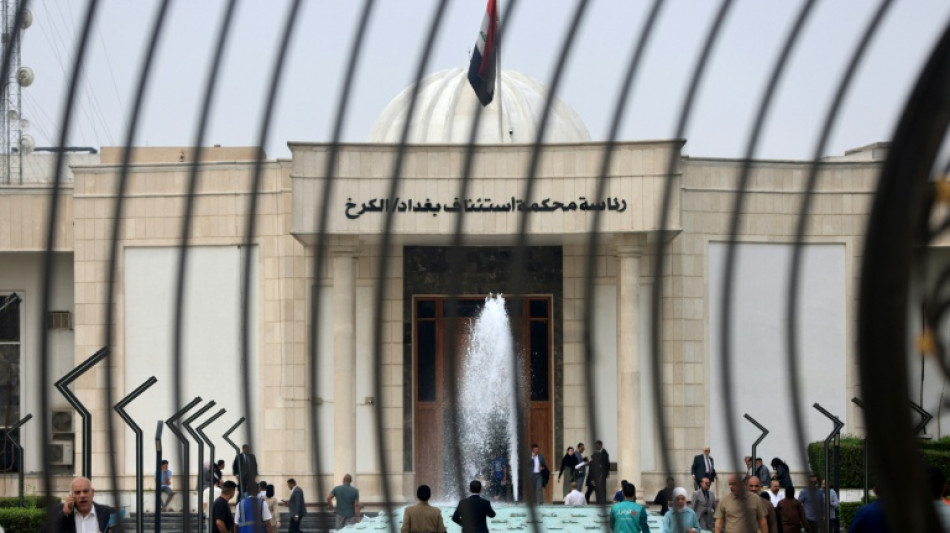
Years on from fall of IS, French jihadists face justice in Iraq / Photo: AHMAD AL-RUBAYE - AFP/File
A decade ago, the Islamic State group broadcast its crimes as it recruited radicals from around the world and imposed a brutal system of oppression across swathes of Syria and Iraq.
Years on from the group's military defeat, accused members are again in the spotlight -- this time on trial in Iraq, including French nationals, for atrocities committed against the people trapped in the so-called caliphate.
Trials began in September for 47 French citizens who were transferred from Syria last year, charged with belonging to the group that controlled large parts of both countries between 2014 and 2017.
In its first verdicts handed down last week, Baghdad's Karkh Criminal Court sentenced nine men to jail terms of up to 20 years.
A 24-year-old defendant, taken to Syria by his mother more than 10 years ago, was given 15 years. AFP is withholding his identity for legal reasons.
When the sentence was announced, the man said in Arabic: "I went to Syria, but it was my mother who chose for me. What is my fault?"
- 'Deceived' -
Thousands of people travelled from Europe to join IS during the war in Syria, where it declared a caliphate in 2014.
France, while repatriating hundreds of family members of jihadists, has refused to bring back most of the men accused of involvement, leaving them to face justice abroad.
Many French recruits were from disadvantaged suburbs of major cities and faced limited opportunities. They included descendants of immigrants, as well as converts to Islam.
The group imposed an extreme interpretation of sharia, forcing women and girls into sexual slavery, and jailed or killed anyone who dared speak out against its atrocities.
Fear was the group's instrument of domination over areas where women were hidden from view and where executions were carried out by bearded militants in public squares, for all to see.
Now, the accused are now being brought to court with shaved faces, wearing orange jumpsuits.
About 1,500 French people are believed to have joined IS.
Among them was Kamel Ben Mbarek, 42, who said he had worked as a driver for the group's Islamic police in Raqqa, in northern Syria.
"I regret it... because I wasn't young when the organisation deceived me," he told the court.
Driven by "anger at the abuses of the Syrian regime", he embraced an ideology "that retained only certain passages of the Quran" -- a manipulation he only realised when he read the holy book in prison.
Fewer than half of the French defendants have appeared so far.
"I regret everything I did. I've lost everything," said Adel Bouaoun, 28, accused of taking part in IS operations in Syria's Aleppo and Palmyra.
He recounted harsh conditions in Kurdish-run prisons in Syria, saying detainees had died, and described "physical and psychological torture".
IS was defeated in Iraq in 2017 and then in Syria in 2019 by a US-led coalition.
Thousands of jihadists, along with their families, were left in Syrian prisons and camps under Kurdish command.
Earlier this year, the new Syrian authorities that came to power after the fall of Bashar al-Assad took over the prisons holding the jihadists.
The US army then transferred more than 5,700 detainees of about 60 nationalities to Iraq, including at least five French nationals.
Rights groups have criticised the judicial process, calling it rushed and saying that confessions were extracted under duress.
"This entire procedure is a form of pressure. You have recorded statements that are not mine," Lakhdar Sebouai, 34, said in court.
Also among those awaiting trial is Adrien Guihal, who claimed responsibility on behalf of IS for the July 2016 attack in Nice, when a truck rammed Bastille Day crowds, killing 86 people.
- 'Law of the jungle' -
At one hearing, three defendants were visibly moved when they saw their siblings, who had come from France, for the first time in years.
The judge allowed them to speak together for a few minutes.
In October, French lawyers Matthieu Bagard and Marie Dose, who are defending many of the 47 French nationals, said the Iraqi judiciary had barred them from entering the country to attend the hearings, after they described the detainees' treatment as "inhumane".
The two lawyers are calling for the defendants' repatriation to France so they can be tried there.
Two Iraqi lawyers appointed in their absence refused to speak to AFP.
"Even if his sentence is different, he was tortured like an adult and tried like an adult," Bagard told AFP, referring to the 24-year-old taken to Syria as a child.
Observers, representatives of the French embassy and journalists are attending the trials.
Rights groups fear death sentences will be handed out.
Before the court, Thomas Barnouin, 45, whose verdict is expected November 18, recalled travelling to Syria at the start of the conflict, convinced that he had a religious duty.
But "the organisation applied the law of the jungle, not the law of God", he said.
"We did not know that it also wanted to carry out terrorist attacks in our own country, in France," he added.
"I reject all its crimes."
F.Lewis--CT