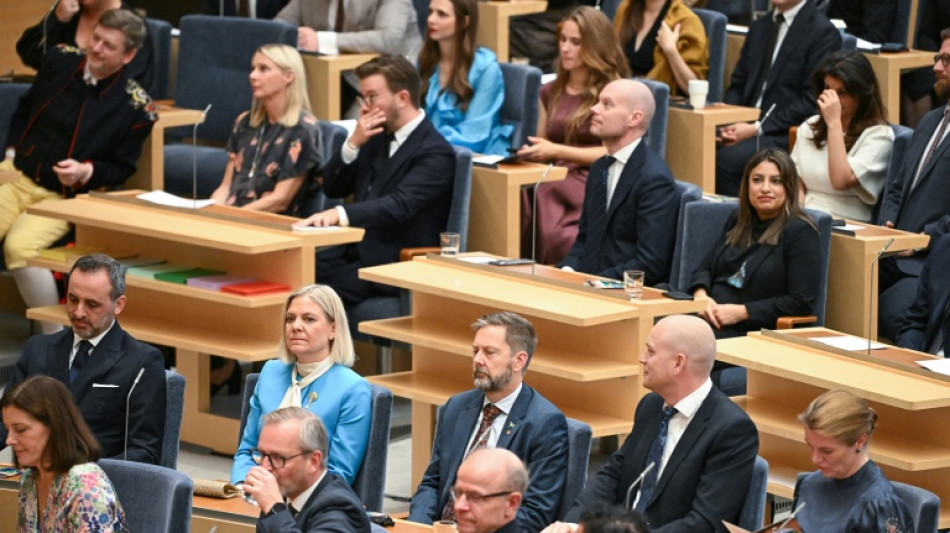
Sweden centre-left leader fails to form government / Photo: Jonathan NACKSTRAND - AFP
Sweden's Social Democratic party leader Magdalena Andersson said Tuesday she had failed to form a government with the three other parties in the left-wing bloc following last month's election.
"My overall assessment is that progress has been made, but at the same time, the conditions are currently not in place to form a government that can be tolerated by the parliament," Andersson told a press conference.
She spoke after reporting back to parliament speaker Andreas Norlen, who had tasked her with gauging conditions to form a government after the September 13 elections.
Shortly after Andersson's announcement, Norlen told a separate press conference that parliament would still be asked to vote on Thursday on whether to make her prime minister, while conceding that Andersson would likely fail to pass the vote.
After that vote, Norlen said he would speak to the party leader once again to reassess who the next candidate should be.
Sweden's centre-left opposition bloc won 176 seats in parliament, versus 173 for outgoing Prime Minister Ulf Kristersson's right-wing bloc, which includes the anti-immigration Sweden Democrats, in the September 13 election.
In Andersson's bloc, the Centre Party has said it will oppose a government that includes cabinet posts for the Left Party, which has in turn insisted it will only support a left-wing government of which it is a member.
Under the Swedish system, a prime minister can secure office so long as a majority in parliament does not vote against them.
Norlen first tasked Andersson with starting government talks on September 18, but she gave up on September 28, after failing to unite the three other parties in her group due to deep ideological differences.
- 'Take some time' -
With no apparent changes in the parties' positions, Andersson was tasked with trying again.
"It is a complicated situation in parliament and also the positions that the centre party and the left party have taken, they are incompatible at the moment," Andersson told AFP following her announcement.
"For me it has been clear after the election result that this will be a complicated process, and that will take some time," she continued.
Andersson also that there could be "more openness for progress" after parliament's vote.
Sweden has become accustomed to lengthy negotiations to form a government. After the 2022 election it took 37 days, and 134 days in 2018.
After Andersson's attempt, Norlen is expected to assign the task to Kristersson, who currently leads a caretaker government.
Speaking to reporters, Norlen said he considered Kristersson a potential next candidate but the speaker did not wish to commit to that too soon and would "respect the process".
Kristersson would need to convince an opposition party to support him or at least not vote against him.
The speaker of parliament has four attempts at proposing a prime minister for parliament to vote on. If the fourth attempt fails, a snap election must be called.
E.Clark--CT