OSCE's 'chaotic' Ukraine evacuation put staff at risk: leaked report / Photo: - - AFP
A confidential report into the OSCE's "chaotic" evacuation of its monitors from Ukraine after Russia invaded four years ago is damning about how it put its own staff at "serious security risk", AFP can reveal.
It comes as the Organization for Security and Cooperation in Europe is angling to send a mission back to Ukraine to monitor any eventual ceasefire.
The internal inquiry seen by AFP blasts the organisation's "insufficient preparedness" and lack of a "standing security risk assessment and an up-to-date and operational evacuation plan".
A month before the invasion an order was even given to "destroy preparatory work done for the evacuation and cease further planning going ahead to avoid 'creating panic' in the host country", the report says.
One Ukrainian staffer, Maryna Fenina, was killed during the Russian assault on her hometown Kharkiv on March 1, 2022, while three others who stayed on in the rebel-held east were arrested and are still languishing in Russian prisons.
The OSCE, of which both Russia and Ukraine are members, believes it can be a key player in moves to end the war.
It has proposed sending a new monitoring and verification mission to Ukraine should a ceasefire be negotiated, with top OSCE officials visiting Moscow in February.
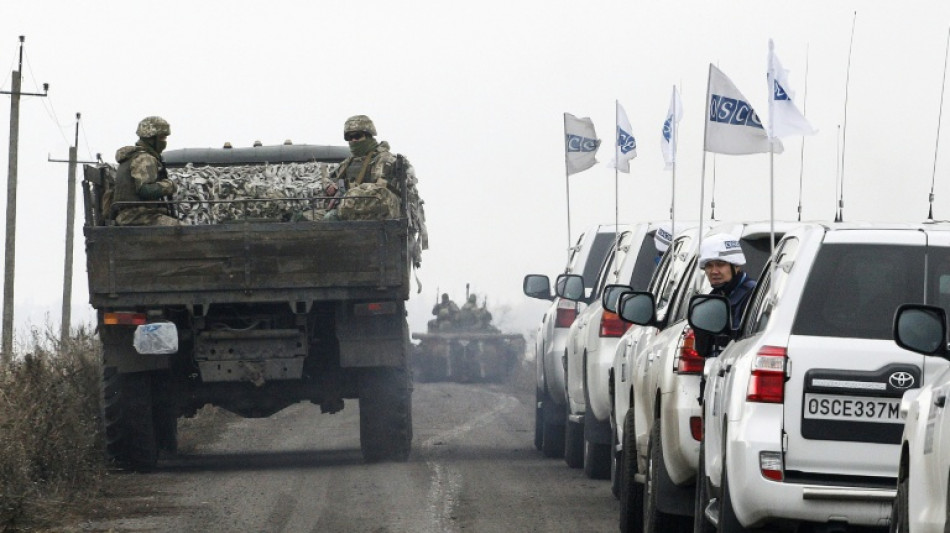
Local and international staff from the Vienna-based body had been monitoring a ceasefire with Moscow-backed separatists in eastern Ukraine since 2014 when war broke out.
One of the staffers, American medic Joseph Stone, was killed in 2017 when his armoured vehicle struck an anti-tank mine in a part of rebel-held Lugansk, with two of his colleagues wounded.
- Staff still in jail -
While the OSCE managed to get hundreds of its staff to safety when Russia invaded in 2022, "a number of vital and sensitive records were not evacuated during the emergency evacuation," said the report, compiled as part of a "lessons learned" process.
"There was and continues to be a high concern of sensitive information being released that can lead to NMM (locally-hired 'national mission members') persecution," it added.
The three jailed Ukrainian employees -- Dmytro Shabanov, Maxim Petrov and Vadym Golda -- were convicted of espionage by Russian authorities, charges which the OSCE strongly disputes.
The report, dated September 2022, highlights "a general lack of clarity of roles, responsibilities and decision-making authority of all the stakeholders involved".
"Plans were not properly and timely communicated" by senior management of the Special Monitoring Mission to Ukraine to staff nor "reinforced through training and exercises", it added.
This "led to somewhat chaotic movements of people and assets out of Ukraine and within the country, posing a serious security risk and complications".
- Countries wanted to withdraw -
Some nations in the Ukraine mission had been pressing since "late autumn 2021" for the OSCE to plan for a possible withdrawal, according to the report's annexes.
But a number of other states, and the OSCE chair and its secretariat had "a strong desire" to preserve the mission, even reinforce it.
Then in mid-February -- just over a week before the invasion -- the United States, the United Kingdom, Canada and Denmark said they were withdrawing their contingents, while Netherlands and Sweden announced partial withdrawals.
With the opposing positions, it was "very difficult for the mission to develop and communicate contingency plans without potentially exposing itself politically", the report said.
The decision was not "coordinated in advance" with the mission's leadership and placed it "in a difficult position at a particularly sensitive time," it added.
The OSCE -- which was set up in 1975 during the Cold War -- said it had "strengthened our crisis response framework" since the invasion, taking on board the findings of the "lesson learned" reviews.
"We have also introduced regular crisis response training through simulation exercises," a statement added.
"Each exercise stress-tested crisis preparedness and response elements of both field operations and the OSCE Secretariat, identifying areas for improvement and honing coordination between executive structures," it said.
"The lessons learned from 2022 also contributed to continued efforts to ensure that staff and assets are adequately prepared in the event of a critical incident," the OSCE added.
R.Brown--CT