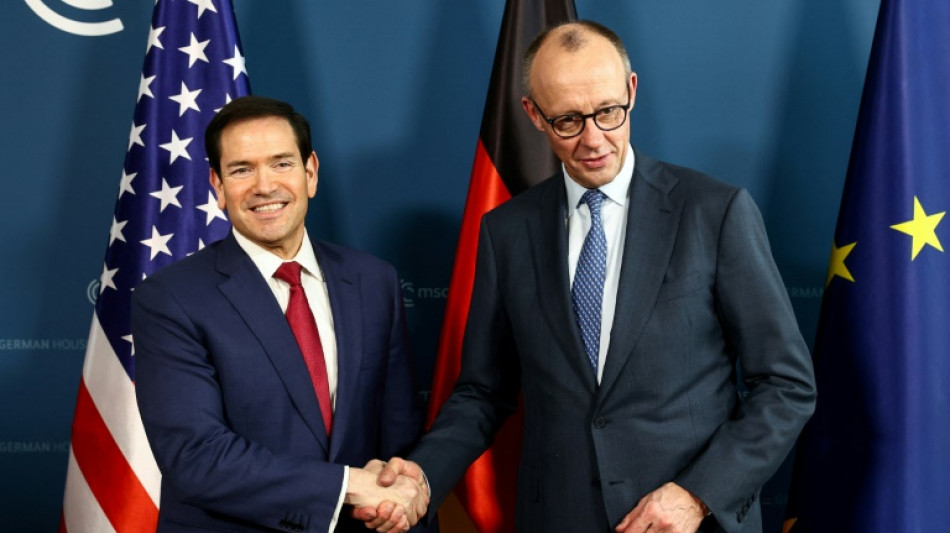
Rubio at Munich security meet to address Europeans rattled by Trump / Photo: Liesa Johannssen - POOL/AFP
US Secretary of State Marco Rubio was set to address European leaders on Saturday as they try to step up their autonomy in defence while salvaging transatlantic ties badly strained under President Donald Trump.
Bruised by Trump's designs on Greenland and his often hostile comments about America's traditional bedrock allies, European leaders gathered at the Munich Security Conference have pledged to shoulder more of the burden of shared NATO defences.
Key leaders have pushed the message that this is essential for Europe to counter a hostile Russia, with NATO chief Mark Rutte saying that "a strong Europe in a strong NATO means that the transatlantic bond will be stronger than ever".
"This is the right time for a strong Europe," said French President Emmanuel Macron, who stressed on Friday that the continent was "clear in the support of Ukraine" and "building its own architecture of security".
"This Europe will be a good ally and partner for the United States of America."
British leader Keir Starmer was expected to tell the conference that Europe is "a sleeping giant" and must rely less on the United States for its defence.
"I'm talking about a vision of European security and greater European autonomy that does not herald US withdrawal but answers the call for more burden sharing in full and remakes the ties that have served us so well," he will say, according to his office.
Rubio is seen as a more conciliatory choice of US envoy, a year after Vice President JD Vance used the same stage to attack European policies on immigration and free speech, shocking European allies.
The Trump administration's new National Security Strategy similarly launched an unprecedented attack against Europeans, charging that the continent is threatened with "civilisational decline".
Ties plunged further last month when Trump stepped up threats to annex Greenland, an autonomous territory of NATO ally Denmark, forcing European nations to stand firm in protest.
- Ukraine war in focus -
German Chancellor Friedrich Merz acknowledged a "rift" had opened up between Europe and the United States, fuelled by culture wars, but issued an appeal to Washington: "Let's repair and revive transatlantic trust together."
"In the era of great power rivalry, even the United States will not be powerful enough to go it alone," said the conservative leader, who has ramped up defence spending in the top EU economy.
The high-powered Munich meeting of government leaders, diplomats, defence and intelligence chiefs comes shortly before Russia's full-scale war on Ukraine is set to enter its fifth gruelling year.
Ukrainian President Volodymyr Zelensky, who has been in Munich since Friday and meeting multiple allies, was expected to address the meeting on Saturday. No Russian officials have been invited.
At the White House on Friday, Trump urged him to "get moving" to end the war. "Russia wants to make a deal... He has to move," the US leader said.
A German government source said Merz and Rubio met at the conference Friday and discussed "Ukraine, the status of negotiations with Russia and further support for the country, particularly in terms of military aid".
They also discussed Europe's role in NATO and "Rubio praised Germany's steps to strengthen the alliance", the source added.
Macron said a new framework was needed to deal with "an aggressive Russia" once the fighting in Ukraine ends.
Kremlin critic Mikhail Khodorkovsky said he feared "a new cold war" between Europe and Russia in the coming decade, making reopening dialogue with Moscow essential.
"If it makes sense to talk, we are willing to talk," said Merz, but he also charged that "Russia is not yet willing to talk seriously".
D.Taylor--CT