Somaliland centre saves cheetahs from trafficking to Gulf palaces / Photo: Tony KARUMBA - AFP
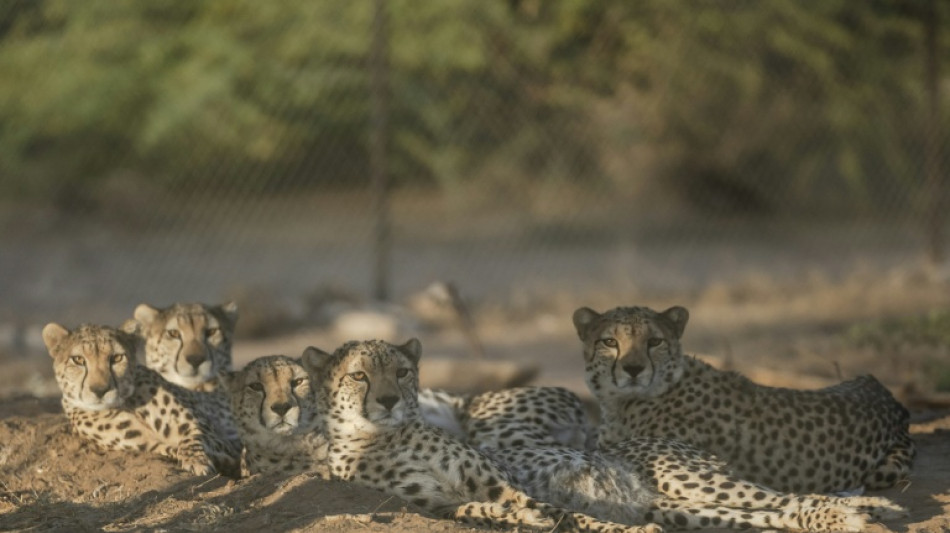
The 127 cheetahs living in a Somaliland sanctuary were all torn away from their mothers to be kept as pets in the Gulf, survivors of a trade that threatens the very survival of the species.
The long, slender, spotted felines yawn, stretch, and purr loudly as the staff approach the vast, highly protected complex run by Cheetah Conservation Fund (CCF) in the Geed-Deeble savannah of Somaliland, a breakaway region of Somalia.
There are just 600 cheetahs estimated to be living in the Horn of Africa -- out of some 7,000 living in the wild worldwide -- meaning the NGO supports a sizeable percentage of the population.
Cheetahs are considered "critically endangered" across Africa, except in its southern region where they are most abundant, by the International Union for Conservation of Nature.
"Boys, come say hello!" calls director Chris Wade to the youngest cheetahs, their hair still shaggy on their heads as they run towards him across a large enclosure.
Eight arrived at CCF together "in a horrible state, dehydrated, riddled with parasites," said Wade. They were part of a group of 11 cubs rescued last year by Somaliland authorities from a smuggling boat.
"We put them in intensive care, but three of them died in three days," he said with a sigh.
- Virtual extinction -
Many are captured in Somaliland or neighbouring Ethiopia before being transported to Yemen via the Gulf of Aden, and then on to Gulf countries, particularly Saudi Arabia and the United Arab Emirates.
The villagers who grab the animals get $50 to $100. The final price is $15,000 to $20,000, said Wade.
Admiral Ahmed Hurre Hariye, commander of the Somaliland coastguard, said they intercepted the boat with the 11 cubs on board thanks to an intelligence tip-off, and showed AFP a video of the cheetahs being found in the shallow hold.
The Emirates passed a law in 2016 criminalising possession and trade of dangerous animals, as did Saudi Arabia in 2022.
"But I'm seeing new cheetahs popping up on Facebook accounts and posts," animal trafficking expert Daniel Stiles told AFP.
"At least in UAE, some cheetahs are still coming in," he said.
For every cheetah cub that reaches its destination, four or five die en route, said Laurie Marker, founder of CCF.
"And once one might reach the Middle East, their lifespan is only about one or two years due to malnutrition and disease as most don't know how to care for them properly," she said.
A 2021 report by the Global Initiative Against Transnational Crime said around 300 cheetahs were smuggled out of east Africa and the Horn of Africa every year, primarily to become "pets for the palatial residences of royal families and the wealthy in the Middle East".
If that rate continues, "the species is headed for virtual extinction," it said.
Somaliland Agriculture Minister Abdilahi Jama Osman said it would be a "disaster" if the trade continues.
"That's what we are fighting against," he told AFP.
- Babies -
Most of CCF's cheetahs have grown too accustomed to humans and are unlikely to ever demonstrate the top speed of 120 kilometres (75 miles) per hour that cheetahs can reach when hunting.
"We got them when they were seven days old," Wade said of the eight youngest.
"Some still had their umbilical cord attached to their bellies. We were giving them the bottle eight times a day. Now they are used to us and there is nothing we can do about it," he added.
But there is hope for the future, as the centre is developing an area to prepare the next arrivals for a return to nature.
"It will be a 1,500-hectare rewilding area. Some of the younger ones could be rehabilitated," Marker said.
Y.Adams--CT