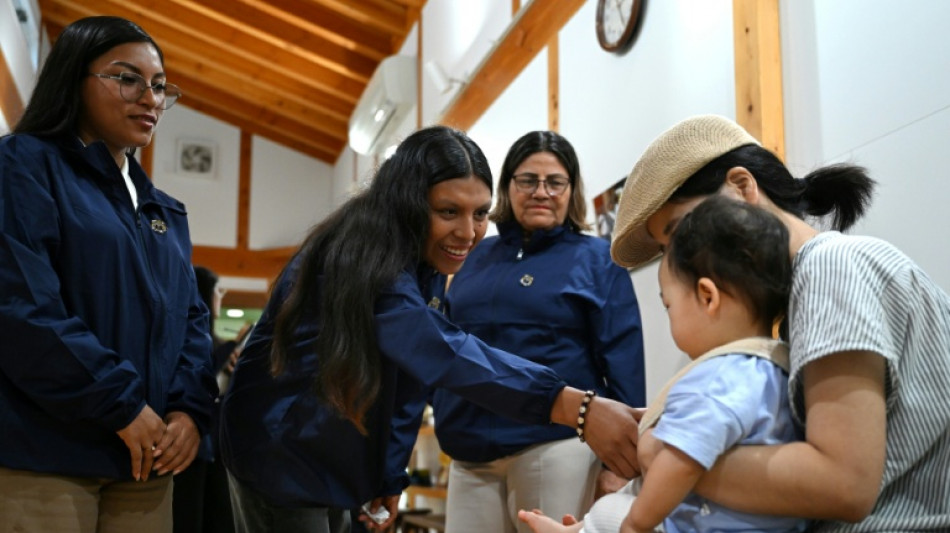
Ageing Japanese village turns to Peru in search of new residents / Photo: Rie KIKUCHI - AFP
In a misty mountain village in Japan, residents recently welcomed unlikely guests from a Peruvian district along the Amazon River, seeing a chance to revive an ageing community facing extinction.
The mayor of Belen and two young women visited a care home on their trip to Nanmoku, a village of just 1,300 people in Gunma Prefecture, greeting the elderly with broad smiles as some looked on slightly puzzled.
"From the moment I arrived, I began to admire everything about this place," 19-year-old student Wendy Sangama told AFP during a week-long tour of Japan that followed the signing of a sister-city agreement between her hometown and the village last year.
"And yes, it's a town where I could see myself living and settling down," she said.
The village is the oldest municipality in Japan, with 70 percent of its residents aged 65 or above. A 2014 think tank report described it as "most at risk of disappearing".
The main street along the Nanmoku River is lined with houses and shops, some abandoned, and appeared largely deserted on the rainy weekend AFP visited.
Village officials hope the sister-city agreement, which promotes cultural and people-to-people ties, will ultimately attract young people from Belen to live in Nanmoku, although how they might obtain residency remains unclear.
While Peru has the world's third-largest population of Nikkei -- Japanese immigrants and their descendants -- Nanmoku Mayor Saijo Hasegawa told AFP the pact was down less to strategy than to a chance meeting with a Japanese-Peruvian businessman.
The village needed "to broaden its horizons and attract more residents, including foreigners", no matter where they came from, he said.
"Without them, we could reach a point where even public transportation stops operating."
- 'No work' -
Despite its rapidly ageing population and labour shortages, opposition to immigration is growing within Japan, prompting a push by Prime Minister Sanae Takaichi for tighter regulations on foreign nationals.
Nanmoku has tried various initiatives to attract young people from elsewhere in the country, but employment opportunities remain scarce, and farmland is limited in the mountainous area.
"Around 60 people die each year here, and just two or three babies are born," Hasegawa said.
Belen, meanwhile, is young. The impoverished district of Iquitos, a remote Amazonian city in northeastern Peru, has a median age of about 27 years old.
Home to more than 60,000 residents, the "Venice of Latin America" -- accessible only by plane or boat -- is filled with wooden houses built on stilts to withstand seasonal flooding.
"I think the young people would be more enthusiastic about wanting to settle in other cities because of the economic situation we have," Mayor Lina Arista Lopez told AFP.
The district's residents rely largely on informal trade and agriculture, growing crops such as yuca, rice and corn.
"We have a harsh reality in Belen," Lopez said. "There is no work."
Ketsi Yahuarcani, a 23-year-old student, called the visit to Nanmoku "incredible", citing the sense of warmth she felt.
"If I had the opportunity to settle here, I would," she said.
Sangama, the other student, said moving to the Japanese village could be "a better option" if it allowed them to build a brighter future and support their families back home.
Not being able to see her family regularly, however, would "certainly be a challenge", she conceded.
- Putting down roots -
While municipalities near Nanmoku have accepted foreign workers, particularly caregivers, it has typically been via short-term programmes for skilled workers and technical interns.
Mayor Hasegawa said his vision was different.
Rather than attracting people who stay only a few years for work, he hopes to welcome residents of Belen as fellow villagers ready to build long-term lives in Nanmoku.
"The approach of simply bringing in workers from an agency just because we're short-staffed isn't right for our village," he said.
Yuki Wanibuchi, 34, who moved to Nanmoku several years ago from the Kyoto area, said potential newcomers would face hurdles, including the language barrier.
"You cannot live here without a car, and getting a driver's licence will require Japanese skills," Wanibuchi said.
"But personally, I think it's more interesting when people from different backgrounds come here to live."
Hiroshi Ihara, an 87-year-old villager, told AFP he had watched his community grow greyer and greyer, with young people, including his three children, moving to bigger cities to make a living.
"I want more younger people to come and live in the village," he said.
"The Japanese population is shrinking. I think it would be best if people from overseas could come here and do what they can to support us."
G.Sanders--CT