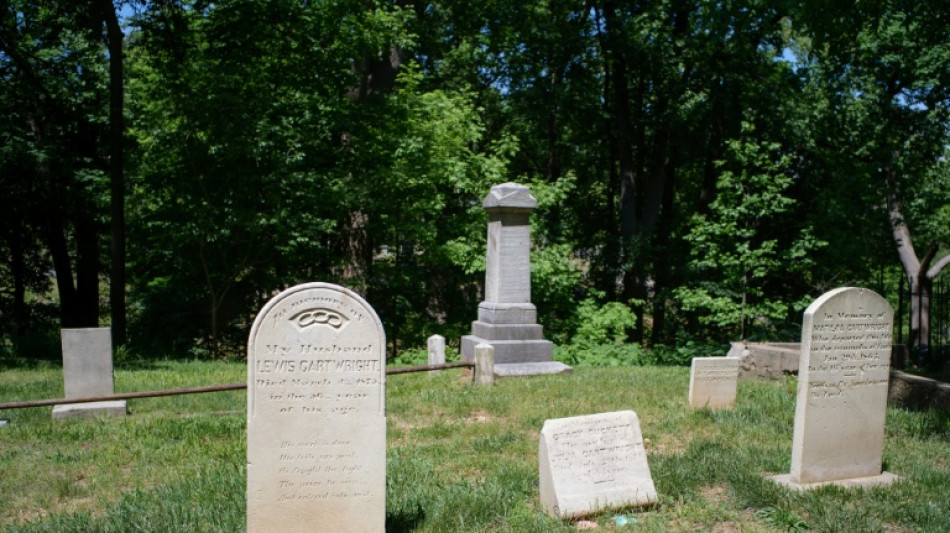
In Washington, the fight to preserve Black cemeteries / Photo: Mandel NGAN - AFP
Georgetown, one of present-day Washington's most expensive neighborhoods, used to be a hub of Black life in the US capital.
Little remains of this history since gentrification began in the 1930s, but remnants of its African American roots can be found in cemeteries that have suffered from decades of disrepair.
The Black Georgetown Foundation is working to preserve the memories of the estimated eight-to-ten thousand people buried in two cemeteries: of Mount Zion Church, one of the oldest Black churches in the city, and the Female Union Band Society, founded in 1802 and 1842, respectively.
"We have a spiritual obligation to uplift and preserve the memories of those who are buried here,” said the foundation president, Neville Waters, whose great-grandfather Charles Turner -- freed from slavery when he was six years old -- is among those interred there.
The site is owned by a trust and the Mount Zion United Methodist Church, which is still active to this day.
A walk through its leafy surroundings offers a snapshot of the past.
There is a stele marking the 1851 gravesite of Reverend Cartwright, who was also born into slavery and went on to become the first Black Methodist pastor in the Baltimore, Maryland area.
A few steps away is the final resting place of Nannie, a seven-year-old girl who died in 1856, her gravesite decorated with toys.
But time and neglect have taken their toll.
In 1930, a bridle path, now a bike trail, was put down over some of the grave sites.
"We have leaning headstones, we have broken headstones, we have headstones that look like they don't have anything on them," Lisa Fager, the Black Georgetown Foundation's executive director, told AFP.
"We're trying to name everybody, and so there's a lot of research," she added.
So far the organization has recovered around 4,500 names.
- 'Spiritual obligation' -
Facing the burial sites is Oak Hill Cemetery, founded in 1848, where only a small handful of people of color have been laid to rest.
With its neat rows and manicured headstones, the cemetery stands in stark contrast to its majority-Black neighbors.
Antoinette Jackson, an anthropology professor at the University of South Florida, oversees the Black Cemetery Network, which catalogs African American cemeteries across the United States.
The network's index of 210 sites, about three-quarters which have been covered by various developments, are the "tip of the iceberg," she explained.
"Many of these cemeteries would never, ever resource in the same way as particularly white cemeteries," the researcher said, adding that during segregation in the United States, "the oversight, the protection, the legal means that typically go into what you do with the cemetery was not extended to black folks."
In 2022, Congress passed a law on the preservation of Black cemeteries, the African American Burial Grounds Preservation Act, but the program has never been funded.
- 'So we don't forget' -
Among the preservation challenges facing the cemeteries is the issue of flooding, as wastewater from nearby streets gets channeled into the burial sites.
The fight came to a head in 2021 with the Black Georgetown Foundation raising the issue with the city, and in late 2025 construction began to work on rerouting the water.
"We've had problems with flooding because there was limited sewage and water management here," Waters said, adding that "we are embarking on sort of a second renaissance" now.
The group also received a $125,000 restoration grant from the city in December 2025.
"Now we want to turn this into a historic memorial park," Fager said of the Mount Zion and Female Union Band Society cemeteries, "so that we can tell American history and make sure that people remember that there was a Black Georgetown."
"I think that because of the political climate we're in, it actually draws people closer to want to know more about American history," she continued.
The Black Georgetown Foundation offers tours of the cemeteries to school groups and organizes holiday events, including for Juneteenth, which marks the end of slavery in the United States.
In 2023, the grave site for Nannie -- the seven-year-old girl -- was burned, Fager said, holding a charred toy in her hands.
"This is why we keep that, so we don't forget," she said.
R.Morgan--CT