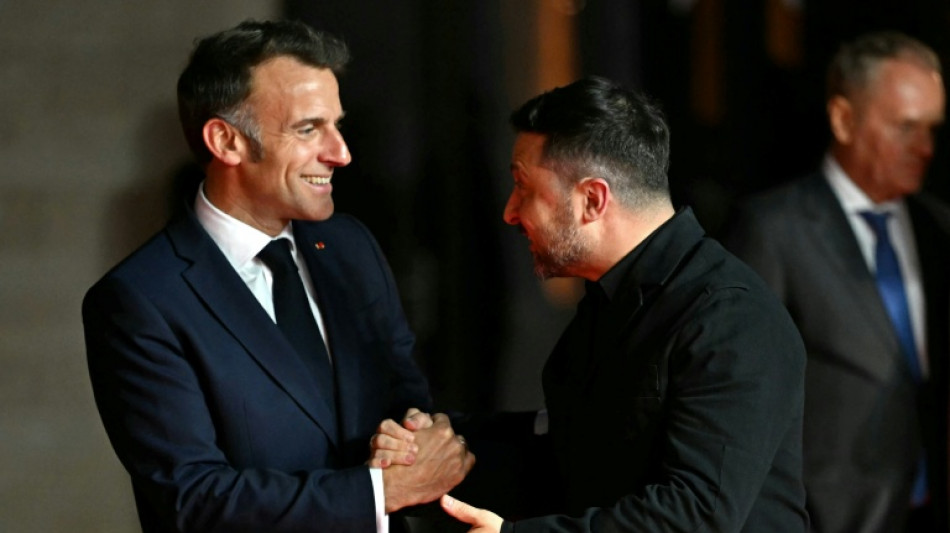
EU unblocks funds as Ukraine presses for membership progress / Photo: NICOLAS TUCAT - AFP
European leaders celebrated the long-awaited approval of the release of a 90-billion-euro ($105-billion) loan for Ukraine on Thursday, but Ukrainian President Volodymyr Zelensky quickly pushed the debate back to his country's EU accession.
After months of wrangling with Hungary, the final sign-off for the loan and a new package of EU sanctions on Russia boosted Zelensky as he touched down for talks with the bloc's leaders in the resort town of Ayia Napa on Cyprus.
Zelensky said he was "very grateful" for the funds that will help Kyiv keep its army equipped and show Moscow that Europe's backing for Ukraine remains strong.
But then he told reporters he wanted EU leaders to move Ukraine to the next step in its bid to join the bloc.
"We will push everybody," Zelensky told reporters outside the seaside conference venue, adding that "of course" his dream was to make Kyiv a member by 2027.
Ukraine's path forward appears to have become easier now Hungary's nationalist leader Viktor Orban is on his way out of power after losing elections this month.
Orban had refused to allow the opening of negotiating "clusters" between Ukraine and the EU.
European Council President Antonio Costa, who represents the 27 member states, said the EU must "look forward and to prepare the next step", which would mean "to open formally the first clusters of negotiations for the European accession of Ukraine".
However, some in the EU are reluctant to fast-track Ukraine's bid and have instead floated a lesser status without full membership rights.
"We must continue to proceed on a merit-based approach," Belgian Prime Minister Bart De Wever said. "Fast tracks are not possible."
Luxembourg Prime Minister Luc Frieden agreed, saying: "You simply cannot become a member of a club without meeting the conditions."
Zelensky has insisted that Kyiv wants full EU membership, not a "symbolic" status.
French President Emmanuel Macron would not be drawn on the question of accelerated membership but called on the EU executive to provide "a precise timetable and outline the actions to be taken in the coming weeks".
- 'Strengthen' Ukraine -
Orban, who skipped what was meant to be his last summit, had stalled the 90-billion-euro loan in a row with Zelensky that infuriated his EU counterparts.
Orban used his veto as leverage to get Zelensky to fix a pipeline damaged by a Russian strike. Following its repair this week, Russian oil flowed once more via the pipeline to Hungary and Slovakia.
Zelensky has said the 90 billion euros will be used to "strengthen" the Ukrainian army, boost production in air defence and protect the country's energy grid.
He hopes the money will be disbursed by late May or early June at the latest.
After resolving the row over Ukraine, EU leaders will turn to the Middle East war and its fallout, including skyrocketing energy prices.
Cyprus, which holds the rotating EU presidency, was sucked into the conflict in March after a drone hit a British base on the Mediterranean island.
European leaders will be joined on Friday by counterparts from Lebanon, Egypt, Syria and Jordan for what a senior EU official described as "intensive dialogue".
A key issue for Europe is the Strait of Hormuz, whose effective closure has sent oil prices soaring and crimped supply of jet fuel in Europe.
The European Union's 2028-2034 budget will also be discussed for the first time, with hopes of securing a final agreement by the end of 2026.
The EU executive wants a bigger budget worth around two trillion euros ($2.3 trillion) though national governments are reluctant to pay more.
burs-raz/del/jxb
Q.Cook--CT