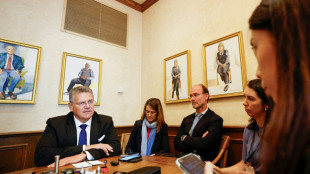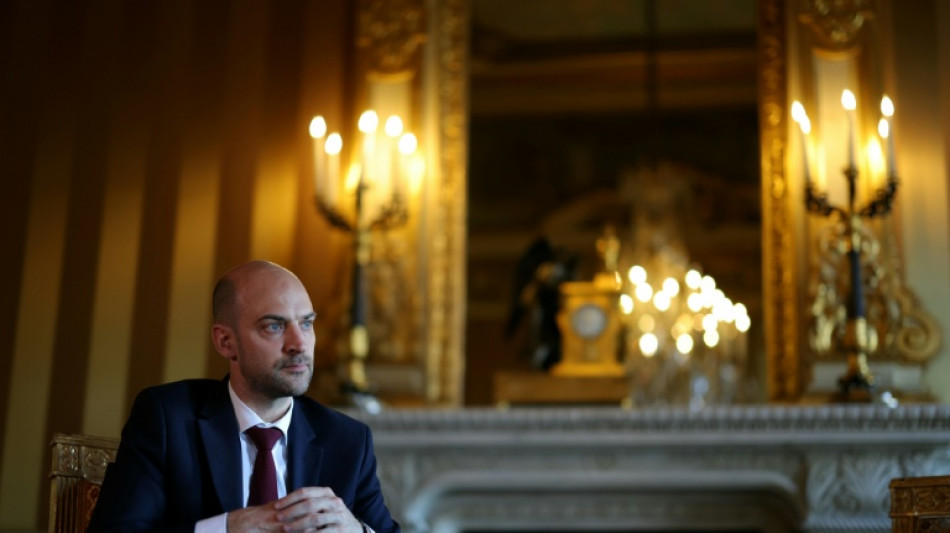
G7 meets in France to mend transatlantic rupture on Iran / Photo: Thomas SAMSON - AFP
Foreign ministers from the G7 meet outside Paris from Thursday, with European nations and allies seeking to narrow differences with the US on the Middle East war while keeping other crises such as Ukraine and Gaza high on the agenda.
The two-day meeting of seven leading industrialised democracies at the Vaux-de-Cernay Abbey outside Paris came as the White House said President Donald Trump was ready to "unleash hell" if Iran does not agree to end the US-Israeli war against the Islamic republic.
Making his first trip abroad since the war started, US Secretary of State Marco Rubio will join fellow top diplomats from Canada, Germany, Italy, France, Japan and the United Kingdom, but only on the second day.
In contrast to usual protocol, and in a sign of the divergence between the US and its allies, there is to be no final joint communique at the end of the meeting.
Instead, the G7 presidency, which is held this year by France, will issue a statement, a diplomatic source said, asking not to be named.
One of the objectives of France is "to address the major global imbalances which explain in many respects the level of tension and rivalry we are witnessing with very concrete consequences for our fellow citizens," French Foreign Minister Jean-Noel Barrot told AFP on Tuesday.
The meeting gets underway from 2:00 pm (1300 GMT) after a morning of bilateral talks with a session on reforming global government. Sessions on Iran and Ukraine are set for Friday, according to the schedule.
With Lebanon pulled into the war as Iran-backed Shia militant group Hezbollah fired rockets into Israel, Barrot also urged Israel to "refrain" from sending in forces to take control of a zone in the country's south.
In a bid to broaden the scope of the elite G7 club -- whose origins go back to the first G6 summit held in the nearby Chateau de Rambouillet in 1975 -- France has also invited foreign ministers from key emerging markets Brazil and India as well as Ukraine, Saudi Arabia and South Korea.
France will also on Monday host a separate G7 meeting bringing together finance ministers, energy ministers and central bank governors, Finance Minister Roland Lescure told RTL radio on Thursday.
The meeting, to be held via video call, will address what Lescure described as a "convergence of energy issues, economic issues and inflation issues".
-'Misguided policies'-
While all G7 nations are close US allies, none have unambiguously offered support for the assault on Iran, angering Trump.
German Finance Minister and Vice Chancellor Lars Klingbeil even complained Trump's "misguided policies" in the Middle East were hitting Germany's economy.
Trump has claimed the US is speaking to a "top person" within Iran's clerical system in talks to end the conflict. But Iranian state TV said on Wednesday Tehran had rejected a peace plan conveyed through Pakistan.
Trump's threat to hit Iranian energy facilities -- which he is now holding back on amid the purported talks -- troubled European allies, who have all called for de-escalation and are not engaged militarily in the conflict.
British foreign minister Yvette Cooper on Tuesday voiced unease that the war had shifted focus away from the Gaza peace plan and violence in the occupied West Bank.
Over four years into Russia's full-scale invasion of Ukraine, Barrot told AFP that support "for the Ukrainian resistance" and pressure on Russia would continue.
W.Scott--CT