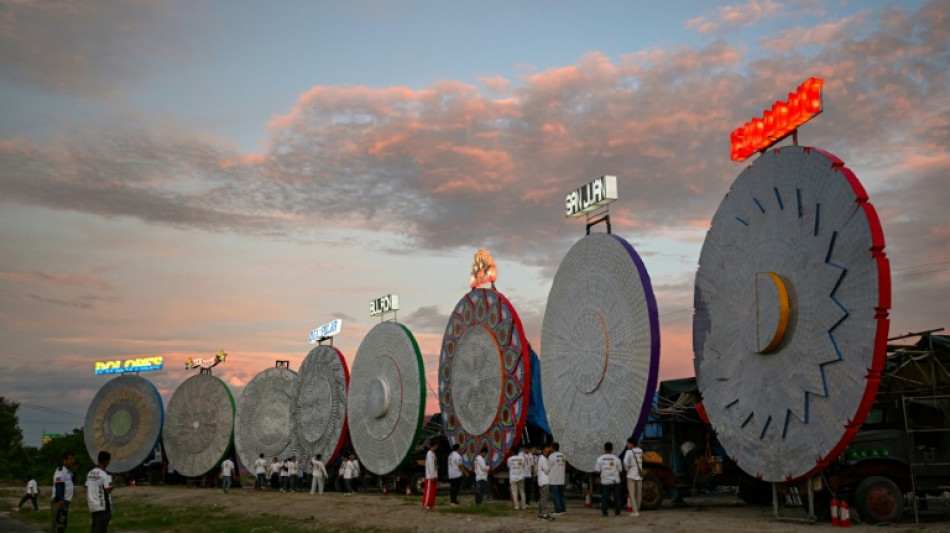
Giant lanterns light up Christmas in Catholic Philippines / Photo: Jam STA ROSA - AFP
In the Christmas-mad Philippines, thousands cheer as hand-crafted lanterns towering six metres (20 feet) high light up the night sky in San Fernando, northwest of the country's capital.
The dazzling display of lights, accompanied by religious and festive imagery and soundtracked by Filipino rap and Christmas carols, is part of the annual Giant Lantern Festival.
Held mid-December each year, the festival acts as a platform to highlight the region's famed lantern industry, which first started more than 100 years ago.
Local designer Karl Quiwa, 31, told AFP it takes a team of 20 over a three-month period to build a light display, adding that he sees the effort as a "religious obligation".
Quiwa's ancestors built their first piece for the inaugural 1908 festival -- which has continued to this day and was only interrupted by war and the pandemic.
The giant lanterns, submitted for competition at the festival, use 12,000 50-watt bulbs synchronised by 15 kilometres (9.2 miles) of electric cables and symbolise the Star of Bethlehem.
The massive light pieces can weigh up to a tonne, with costs soaring to a million pesos ($17,000).
Smaller versions are also produced by the city's craftsmen and adorn lamp posts, office buildings and homes across the archipelago nation of 116 million which is home to Asia's largest Catholic population.
A sixth-generation descendant of San Fernando's pioneer lantern-maker, Quiwa said apart from religion, he was proud to carry on the family tradition of "cheering people up during Christmas".
- 'Cheer, light and hope' -
Fellow designer Edmar David echoed this sentiment, telling AFP that his company sells thousands of lanterns each year -- including to the country's massive overseas worker community.
"Lanterns bring cheer, light and hope. Without them, life is sad," David, 41, whose 2024 entry won best in show, said of the craft.
The lantern-making tradition evolved from nighttime processions held by Spanish friars during the 300-plus years of Madrid's colonial rule, the city government said.
"It's really beautiful and shows the importance of our communities in making Christmas meaningful," local student Ria Hipolito, 16, told AFP as she and other members of her family watched the competition last weekend.
Her uncle, Rodel Hipolito, who was attending the festival for the first time since ending a 15-year stint working in the Middle East, told AFP "lanterns are symbols that light up people's lives".
As the light show unfolded, the lantern's blindingly bright facades concealed a flurry of activity behind, as teams of people turned large metal barrels called rotors by hand to produce a kaleidoscopic effect.
Firefighters carrying extinguishers could be seen patrolling the area, as sparks flew from the rotors of at least three lanterns, AFP journalists at the event saw.
"Almost all the lantern-makers here are related to each other or are friends with the others," said Florante Parilla, 55, who has been designing the giant lanterns for 30 years.
Despite their popularity, those involved in the festival worry technology and apathy could bring the tradition to an abrupt halt -- as fewer young people are learning the craft.
"We're always on the lookout for young people to train, because nowadays, most have not shown any interest," said Parilla.
Quiwa said that only one other lantern-maker at this year's competition was as young as him.
"Most of today's children are introverts who do not play outside and are attached to their cell phones and (computer) games. Maybe that's the reason they cannot appreciate lantern-making," Quiwa said.
"We may be the last of our kind."
E.Brooks--CT