Trump convenes Latin American leaders to curb crime, immigration / Photo: Galo Paguay - AFP
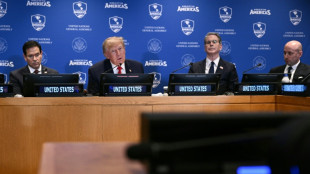
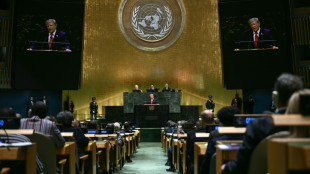
US President Donald Trump will meet Saturday with a dozen right-wing leaders from Latin America and the Caribbean to discuss issues facing the region, from organized crime to illegal immigration.
The "Shield of the Americas" summit also aims to serve Washington by boosting US interests in the region and curbing those from foreign powers like China.
Trump has already staked bold claims in Latin America with the ouster of former Venezuelan president Nicolas Maduro and working with his replacement, Delcy Rodriguez, to claim Venezuelan oil reserves for America.
The summit at Trump's golf club in Doral, Florida -- not far from his Mar-a-Lago residence in Palm Beach -- marks the latest instance of the president moving ahead with his so-called "Donroe Doctrine" of asserting expanded US authority in the Western Hemisphere.
Among the leaders to attend the summit are Argentina's libertarian president Javier Milei, Ecuador's Daniel Noboa and El Salvador's Nayib Bukele -- whose security crackdown is seen as a model for many in the region.
Most of the right-wing heads of state share concern about the rising power of drug cartels in Latin America, a phenomenon that has spread to countries considered fairly safe until recently such as Ecuador and Chile, said Irene Mia, a Latin America expert at the International Institute for Strategic Studies (IISS).
"All those countries used to be quite secure and didn't really have an issue with organized crime, but they've seen increasing levels of organized crime because of the reconfiguration of the drug trade," Mia told AFP.
The strained security situation, which has contributed to the Latin American right wing's recent string of electoral victories, means the trend of US intervention has received less pushback than in the past, she added.
Some of the leaders, like Ecuador's Noboa, have worked to strengthen their ties to Washington since coming to power.
Just this week, the US and Ecuador announced joint operations to combat drug trafficking that has turned one of the previously safest countries in Latin America to among the deadliest in just a few years.
Late Friday, the US military and Noboa separately released video of a house exploding in a forested area of Ecuador, calling it a successful blow against "narcoterrorists."
- 'A very fine balance' -
In addition to Milei, Bukele and Noboa, Trump will host the leaders of Bolivia, Costa Rica, the Dominican Republic, Guyana, Honduras, Panama, Paraguay, and Trinidad and Tobago -- as well as Jose Antonio Kast, the president-elect of Chile.
Although some of the leaders have much to thank Trump for -- such as $20 billion in financial support to Argentina, or an endorsement that buoyed Honduran leader Nasry Asfura's razor-thin electoral victory -- the durability of such a conservative coalition remains to be seen, according to Mia.
"It's entirely a negative agenda," Mia said. "It's all about the threats coming to the region for US security: migration, organized crime."
She also pointed at the glaring absences from the summit, Mexico and Brazil, which are currently lead by leftists Claudia Sheinbaum and Luiz Inacio Lula da Silva.
"Without Mexico and Brazil, it's not going to be very successful in tackling those issues" of narcotrafficking and counterterrorism, she said.
"The Mexican cartels are really the CEO of the drug trafficking supply chain. And Brazil is also so important because its organized crime groups are also increasingly powerful, they control the ports in Brazil and are key for the narco-trafficking towards Europe."
For Mia, the support of the right-led Latin American countries for US interests "is quite fragile because the relationship between Latin America and the US is so problematic."
"It's a very fine balance to see whether the population will approve of Trump's policy and until when."
K.Martin--CT